The video made the case that a successful project is something a project manager can name and own. This lesson follows the video rather than repeating it, and turns that case into working knowledge: the definitions, the boundaries, and the four patterns a project manager falls into under pressure.
Where this fitsBehavior Establish Clarity · Control Advancement · Protect IntegrityOutcome All five outcomesLifecycle Spans the whole project
Recall · before you begin
From orientation, there are four patterns a PM falls into under pressure. Which one is the goal, and what does it own?
The Accountable Owner, the PM who owns the result (the intersections between everyone’s work), not a single lane.
1
Four patterns and the one to build toward
Same afternoon, same firm
The mechanical engineer has found a clash that will cost two weeks, and two project managers get the news within an hour of each other. One writes it up well, with clean notes, a tidy email asking the team to meet, and a paper trail anyone could follow, and then waits for someone else to decide. The other calls the client that afternoon with two options and a recommendation.
The information is the same. The firm is the same. The two projects will look very different six weeks from now.
The program describes four patterns in design-oriented PMs, three of them capable people whose strength in one dimension creates a blind spot in another, and only one of them consistently protecting the outcome. The four name tendencies under pressure rather than fixed identities.
The Competent Coordinator
Tendency
Documents everything: perfect notes, clean logs, every meeting captured.
Blind spot
Mistakes documentation for ownership. The decision still has not been made.
Preferred behavior
Log it, then force the open decision to resolution.
The Obsessed Designer
Tendency
Pursues the best possible design, every detail.
Blind spot
Mistakes design quality for project success. Refines past what the fee funded.
Preferred behavior
Define ‘done’ by the scope the fee bought, then protect the design within it.
The People Pleaser
Tendency
Keeps the client happy in the moment.
Blind spot
Mistakes client satisfaction for client service. Absorbs the hard conversation.
Preferred behavior
Name the change early and bring a clear choice.
The Accountable Owner
Stance
Owns the result rather than a single lane. Owns the intersections between everyone’s work.
Watch-out
Ownership without the three moves becomes overload. Own decisions, not everyone’s tasks.
The standard
Protects the outcome when complexity increases.
2
Which question belongs to the Project Manager?
Most Grace PMs are architects as well, so the two roles overlap in skill and diverge in responsibility, and what separates them is the question each is accountable for answering.
Role
Owns
The line
Project Architect
The design answer: the vision, the details, getting the building right.
“Makes it great”
Project Manager
Whether the whole thing comes together: schedule, budget, client, coordination.
“Makes it real”
Principal in Charge
The client relationship at the top and the firm’s risk, the sponsor role.
Owns the relationship, not the delivery
When the design, the schedule, the client, and the fee start pulling against each other, the call belongs to the Project Manager. It does not belong to the Architect, and it does not belong to the Principal. At Grace, the Project Manager is the Face of the Firm, the one person answerable for how it turns out.
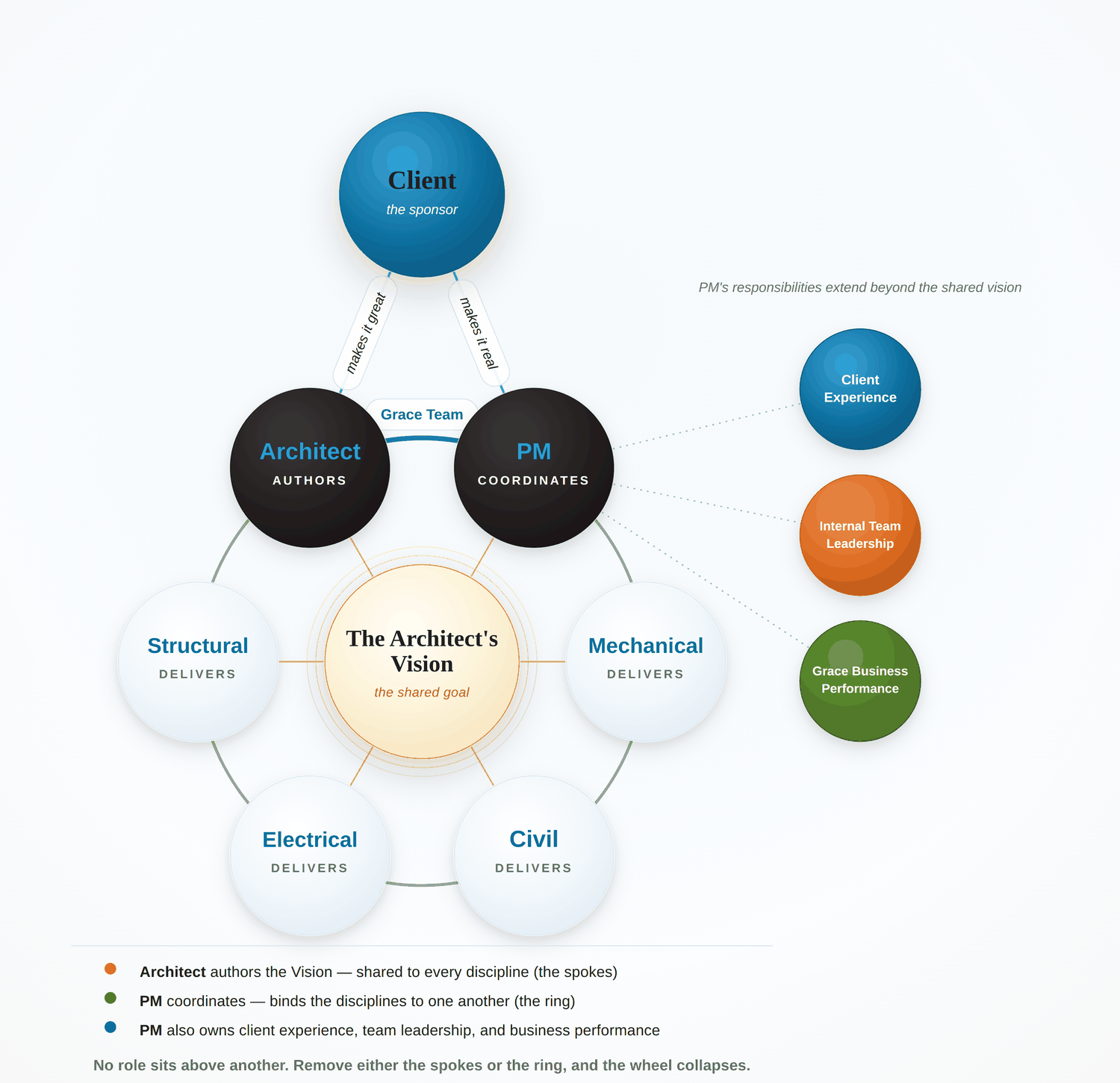
At Grace, the Architect’s vision sits at the center, the shared goal every role serves. The Client sponsors it: the Architect makes it great, the PM makes it real. Together they form the Grace Team. The Architect authors the vision and shares it to every discipline (the spokes). The PM coordinates, binding the disciplines to one another (the ring). The PM’s job extends past the shared vision to client experience, internal team leadership, and Grace’s business performance. No role sits above another: remove either the spokes or the ring, and the wheel collapses.
3
What does a successful project actually produce?
A project can run on time, stay busy, and keep a client satisfied, and still fail on the results that matter. Success at Grace is defined by results that survive the project rather than by activity during it. Five things have to be true.
The five outcomes
What it means
Role
1 · Defined Scope & Aligned Commitments in the video: “clear scope & aligned commitments”
Everyone agreed what the team is building, and what it is not building, before work started.
The work
2 · Controlled, Predictable Delivery in the video: “predictable delivery”
Work moves at a steady pace, and problems are caught early rather than at the deadline.
The work
3 · Protected Design & Technical Integrity in the video: “protected quality”
Quality holds. Reviews are completed rather than skipped. The design survives the budget and the schedule.
The work
4 · Sustained Financial Health in the video: “a healthy fee”
The fee matches the work, and when something costs more, the client decides rather than the team absorbing it.
The reward
5 · Developed Teams & Collaborative Leadership in the video: “a stronger team”
The team gets stronger, and nobody is left cleaning up a problem that was never theirs.
The reward
Remember
The first three outcomes are the work itself. The last two are what the work earns.
4
Why does value multiply rather than add?
Those five outcomes describe a successful project, and asking why they matter reaches the real job of the role: the project manager is the person who creates value. Stripped to a single line, that is the whole program.
VALUE = PERFORMANCE × EXPERIENCE
Did we do the work well × What it was like to work with us
Performance: did we do the work well?
Experience: what was it like to work with us?
Technical quality: the work is right. Value for scope & fees: we do what we agreed to do. Schedule adherence: we deliver when we said we would.
Responsiveness, proactiveness & helpfulness: we meet the client’s expectations for how we show up. Clear & accurate communication: they always know where things stand, and they can trust it.
Value multiplies rather than adds
A zero on either side of the equation produces a zero. A brilliant set delivered in a way that frustrates the client does not average out to ‘fine’. A weak experience pulls the whole result down. Elite work × an elite experience is the only way value gets large. Both halves belong to the Project Manager.
Clients leave over how they are treated, not how the building turns out.
81%
of AEC client losses come from indifference, not from bad work
87%
of AEC firms rank client experience as their #1 differentiator (was 56%)
113%
more likely to be more profitable when firms manage client experience
~25×
the cost to replace a lost client vs. keep one
Clients assume design and technical quality. The experience around the work is what earns repeat clients and referrals, the revenue most firms run on. That is the half of the equation the PM owns end to end.
Sources: SMPS Foundation & Client Savvy, Client Experience in the AEC Industry (2025). ClearlyRated AEC NPS research. HBR / Bain & Co. on retention.
So the first move on any project is curiosity: what does value actually look like for this client, on this project? Getting clear on that before anything else is the foundation of Establishing Clarity, since value that was never defined cannot be protected. Establishing Clarity is also how Grace turns Complexity into Confidence, and why the firm measures impact “not in square footage, but in the lives changed within.”
5
Which three moves produce the five outcomes?
If owning the result is the goal, the three moves are how a project manager delivers it, and each move addresses a specific failure in the gaps between disciplines.
The three moves are the engine. Each directly produces one of the first three outcomes, the work. Do those three well, over and over, and they compound into the last two, a healthy fee and a stronger team. The reward is earned rather than chased directly.
Done well, over and over, through people, those three produce the last two outcomes, Sustained Financial Health and a stronger team, and the reward is earned rather than pursued directly.
?Which move does this need?
A client asks for a change, and you price it and bring them the options instead of absorbing it. Which of the three moves is that?
Protect Integrity. Pricing the change protects the contract and the fee, even when it means a harder conversation.
Remember
Three moves. Five outcomes. The same three moves return in Finance, measured in money.
Why does timing decide the cost? The MacLeamy curve
The three moves only pay off when a project manager makes them early. The MacLeamy curve shows why: at the start of a project the unknowns are many and cheap to settle, and the power to shape the outcome is at its peak. Later, the cost of resolving the very same question climbs steeply, and that power fades.
The MacLeamy curve, read for decisions. Early in a project, unknowns are many and cheap to resolve, and the ability to influence the outcome is at its peak. The Project Manager drives those unknowns down and locks the decisions inside that early window. The cost of resolving an open question rises dramatically the longer it waits. A conflict resolved Tuesday costs two hours. The same conflict resolved Thursday costs eighty.
Read that way, the three moves are one discipline applied in the early window, driving the unknowns down before they become expensive:
Establish ClarityName the decision that has not been made, the one the current work depends on.
Control AdvancementStop the work that rides on it. Momentum on an unconfirmed assumption is risk, not progress.
Protect IntegrityHave the conversation that resolves it: present the choice, enforce the scope, then move forward.
That is why the Accountable Owner acts on the left side of this curve, where decisions are still cheap, while everyone else waits and pays the higher cost later.
A project manager pulls the same three levers in a slightly different shape every day, in every phase, from pursuit through closeout, so value is created continuously rather than delivered at the end.
“Keep me informed. No surprises.”
→
Proactive, clear communication
“See the problem before I do.”
→
Proactiveness & risk management
“Be reachable. Answer fast.”
→
Responsiveness
“Hit the budget & schedule you promised.”
→
Schedule & budget adherence
“Make me feel understood.”
→
Discover what value means here, then set and elevate expectations
“Protect the quality of the work.”
→
QA reviews & technical integrity
Pursuit
Discover the client’s real success criteria beyond scope and fee.
Kickoff
Set the communication cadence and align expectations up front.
Design
Approvals at each phase review. Price changes promptly, in writing.
Construction
Surface issues early, with options, before they become surprises.
Closeout
Measure relationship health (NPS) and cultivate the next project.
Remember
Elevate expectations, then deliver against them. Trust follows, and trust is what lets the firm sell the next project before it is bid.
6
Put it to work
On your throughline project
Name success: which of the five outcomes is most at risk right now?
Find one gap nobody owns, a decision two teams are quietly working around.
Pick the move it needs first: Establish Clarity, Control Advancement, or Protect Integrity. Make it this week.
Challenge · from memory
?Challenge · from memory.
Name the five outcomes, and the three moves that produce them.
Outcomes: Defined Scope, Predictable Delivery, Protected Integrity (the work) → Sustained Financial Health, Developed Teams (the reward). Moves: Establish Clarity · Control Advancement · Protect Integrity.
Then do
“A good project is not luck. Five things have to be true, and making them true is your job.” Watch the module videos →
Before you move on
Tell us what landed this week. It takes about 3 minutes and shapes what we cover in the live session.
 PM Excellence Academy
Module 1 of 12 · The PM Role
PM Excellence Academy
Module 1 of 12 · The PM Role